
2030 Agenda: Country report and stocktaking survey
How well has Switzerland progressed in its implementation of the 2030 Agenda? Sustainable development is a society-wide endeavour that fundamentally links society, the environment and the economy. Every four years, Switzerland submits an implementation report to the UN that is based on an extensive stocktaking survey carried out in advance.
UN country report
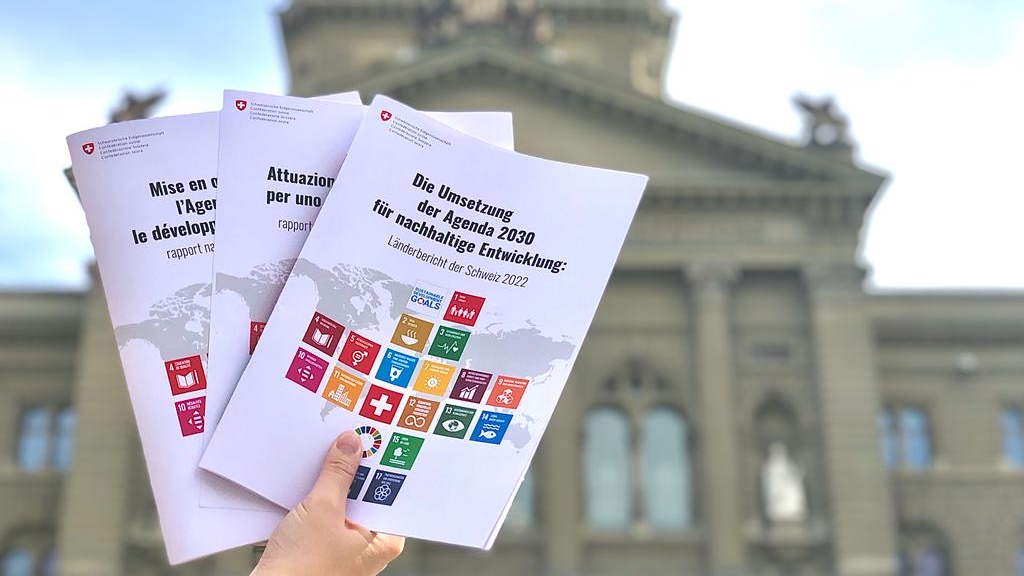
Switzerland takes part in voluntary international reporting on its 2030 Agenda implementation. The UN asks its member states to periodically report on how their countries are implementing the 2030 Agenda. These reports are presented both at the UN High-level Political Forum on Sustainable Development and to the countries’ respective populations. They provide the opportunity to demonstrate achievements, highlight challenges and discuss common developments. Midway through each legislative period, the Federal Council produces a country report on Switzerland for the UN High-level Political Forum on Sustainable Development.
The country report provides an overview of Switzerland’s implementation of the 2030 Agenda, both locally and globally. It presents the main opportunities and challenges facing Switzerland on its way to achieving the 17 global Sustainable Development Goals (SDGs).
The report is accompanied by a statistical appendix, which is prepared by the Federal Statistical Office based on the MONET indicator system.
The first Swiss country report was presented in 2018 and the second in July 2022, with the third scheduled for 2026.
Stocktaking survey
Along with the three levels of government – federal, cantonal and communal – civil society, the private sector and the scientific community all play key roles in advancing the society-wide project of sustainable development. Each party makes essential contributions towards reaching global sustainable development goals through innovative initiatives and concrete activities. Effective cooperation between public, private and civil society partners can enhance synergies for sustainable development while minimising negative impacts.
This is why the country report is based on a comprehensive review with broad-based participation. Expert opinions are gathered from all federal administration departments, while representatives from cantons, communes, civil society, the business world and the scientific community are consulted for their perspectives and evaluations regarding Switzerland’s sustainable development.
The result is a complete picture of sustainable development spanning the last four years, which provides a robust basis for the country report. The complete survey is available in full at SDGital2030.ch, allowing specialists and the general public to view Switzerland’s implementation status for each of the 17 SDGs and 169 targets.
Get involved!
Is your organisation working to achieve the 17 Sustainable Development Goals? Would you like to share your perspective on how Switzerland is implementing the 2030 Agenda? If so, get in touch at SDGital2030@eda.admin.ch so that your views can be incorporated into the survey, helping to paint a fuller picture of the broad array of sustainability policies in Switzerland.
Documents
Find out more
Follow-up and review of the 2030 Agenda
As Switzerland drives forward the implementation of the SDGs, financing is playing a key role while follow-up and review processes serve as tools.
Contact
Federal Department of Foreign Affairs FDFA
Prosperity and Sustainability Division